I have been to SERE twice and taken multiple SABC courses. I feel that, relative to most everyday folks and even weekend adventurers, I have an above average capacity to handle a medical emergency; I can emplace a nasopharyngeal tube, make a tourniquet, and perform CPR.

That said, I think most FAKs are tremendously overcomplicated. Other than a basic few comfort items like ibuprofen, claratin, and hydrocortisone, my FAK consists of three main components:

1) Gauze
2) Duct tape
3) Neosporin

With these three items, I--or most anyone, for that matter--can pretty easily control almost any bleeding, or splint a limb, all while avoiding infection. These are certainly not tools for permanent or even semi-permanent treatments, but they will keep someone alive and reasonably safe from any injury I'd have any business personally treating in the field.

I keep soap and towels in my vehicle as well. Oh, and I sometimes carry super glue, but mine needs replacing. It can be a simple, effective treatment for a bad cut on a finger.
 
Last edited:
  • Like
Reactions: HappyOurOverlanding
$380 for that first aid kit?!?!?! It better come with a tiny doctor in there. That is silly...

I build my own kits most of the time so I don’t have any skin in the game but adding up the prices of this kit plus a little profit for them the price is in line with what it should be. Comprehensive kits are always pricey unfortunately.
 
I would recommend getting something like the wilderness first aid kit from rescue essentials, and tagging on extras like chitosam / quickclot based on your skills and budget.

Wilderness First Aid is great training that directly applies to overlanding / camping type adventures, and is designed around being lightweight and compact, as well as teaching how to MacGuyver a medical situation until better treatment becomes available.

It's the same training many emergency groups like FEMA/ CERT offer their volunteers for disaster situations, so it's no joke but also not beyond average folks.

Hope that helps.

Sent from my ZTE A2017U using OB Talk mobile app
 
Thanks for the great tips and advice on how you came up with your med kit @Hank Outdoors, I think it is crucial that everyone who goes out on any adventure should have some form of a med kit for either a quick day trip or extended haul. Another thing I find useful is to have a separate smaller bag along with the main med kit to take with you in case you go on hikes and would be too much to carry a full med box. We keep ours inside of our jeep in a plastic tool box that's easy to carry but I have been thinking of potentially upgrading to a waterproof case.
 
  • Like
Reactions: Hank Outdoors
@JackP

Totally agree that carrying certain items makes sense, even if you don’t know how to use them. I’m making a list of things to make videos for so that people are at least familiar with certain items. My only comment are the decompression needles. The proper ones are expensive and are not very effective. One study showed they weren’t properly positioned more than 80% of the time. There are better options in regards to placement than the 2nd intercostal space which is the current standard location. I carry them on the helicopter but wouldn’t use it in the back country on a trip unless the patient was pulseless and had chest trauma as a “I hope this works”.

For everyone, please either pm me or post up specific skills or topics you’d like to see videos for.

Chris.
I would be willing to help you with these videos if you need anything. I am currently a US Army medic, EMT-B, and PALS certified. I despise NCD catheters, but I guess I wouldn't want someone putting a chest tube in me on an off-road adventure either. That's like getting Intra Osseous lines for fun, no thank you. Those NCD catheters get clogged so easily. We occasionally see 6-7 in a single person, because once they are in, they stay in until chest tube is complete. Better off buying a few NCD's, better safe than sorry, and some dang good communications with wonderful helicopter pilots.
 
  • Like
Reactions: Hank Outdoors
DO NOT FORGET your prescribed meds, blood pressure, insulin, auto injectors, nitro. Always beneficial to put a few in your first aid. Take Epi pens (check current recall info) for people with allergies. Familiarize yourself with crics and have the proper equipment to conduct one safely. It is a very small kit. Very well can save your life if having an allergic reaction and loosing your airway. Crics shouldn't be your first step, but not a bad thing to have in your "tool box". Or you can just take me on your adventures, problem solved. I volunteer.
 
DO NOT FORGET your prescribed meds, blood pressure, insulin, auto injectors, nitro. Always beneficial to put a few in your first aid. Take Epi pens (check current recall info) for people with allergies. Familiarize yourself with crics and have the proper equipment to conduct one safely. It is a very small kit. Very well can save your life if having an allergic reaction and loosing your airway. Crics shouldn't be your first step, but not a bad thing to have in your "tool box". Or you can just take me on your adventures, problem solved. I volunteer.
This is magic right here, and surprisingly so many people don't really consider it.

I will also toss in having a few items to help out a fuzzy friend is a good idea if you happy to travel with any. They even make reasonably priced kits just for dogs that you can get, or just pull ideas from since many of the tools work for us too.
 
  • Like
Reactions: Russell Peters
I carry 2 first aid kits. The first is a basic trauma kit! As a EMT I have protocols I must follow, and they are only legal when I'm in my jurisdiction. If I do ANYTHING more than basic care away from my medical directors oversite I am practicing medicine without a license. So sorry no chest tubes or decompresson needles or airway adjunks...just the basic gear. If I have all the extra stuff then I'm tempted to use it.
My second bag is my family bag, it has all our medications and specific stuff for us. The separation keeps stuff from getting confused.
Also don't forget to inventory your kits regularly. Some stuff expires, and you keep somewhat familiar with what's in your bag.
 
I carry 2 first aid kits. The first is a basic trauma kit! As a EMT I have protocols I must follow, and they are only legal when I'm in my jurisdiction. If I do ANYTHING more than basic care away from my medical directors oversite I am practicing medicine without a license. So sorry no chest tubes or decompresson needles or airway adjunks...just the basic gear. If I have all the extra stuff then I'm tempted to use it.
My second bag is my family bag, it has all our medications and specific stuff for us. The separation keeps stuff from getting confused.
Also don't forget to inventory your kits regularly. Some stuff expires, and you keep somewhat familiar with what's in your bag.
Very smart.
 
I know a lot of people that over look simple items like a tourniquet, quick clot, NPA or decompression needle because they are not trained to use them. Keep in mind that you may not know how to use one of those items but someone who may come across you may be trained.

In all of my first aid kits (I have a big expedition kit in a pelican box, and smaller kayak kit, hiking/day kit and ones in my minivan and tundra) I have a bunch of Israeli bandages, they are a sterile gauze pad paired with an ACE bandage and when deployed can supply well-aimed direct pressure directly on a wound while you are working on something else. The other things all the bigger kits have are tampons, and maxi pads, They are great at absorbing large amounts of fluids! The big kits also have cheap safety glasses.
Last big thing is to standardize kits of similar sizes. Just once I opened the minivan kit and discovered it was not packed like the truck kit, and now, fixed it. both kits have all the same bits.

I have had a WFR in the past and currently have WFA, I cannot say enough about the courses, a WFA can be picked up over a weekend (REI offers it for 265) and a WFR will set you back 6-800 bucks, and a full week, but, it totally changed my world.
 
  • Like
Reactions: HappyOurOverlanding
I’m with you on keeping things simple. After a few years of outdoor guiding and dealing with the occasional real-world injury, I’ve learned that most “all-inclusive” kits end up being bulky, overpriced, and filled with items that never get used. Your setup of gauze, duct tape, and Neosporin honestly covers 90% of what the average person can realistically handle in the field.

One thing I’ve been doing lately is building my own kits but using modular components. FlareSyn has been useful for that because their gear leans toward practical, non-gimmicky items rather than stuffed-to-the-brim bundles. Checking their website helped me compare individual components so I’m only buying what I’ll actually use instead of paying for a giant pre-packed kit.

The price of some commercial kits definitely shocks people, but when you piece things out, a lot of the cost comes from premium brands and supplies most folks won’t touch unless they’re trained. For general outdoor use or glovebox emergencies, I’d rather have a small, efficient kit I know how to use than something that looks tactical but isn’t any more effective.

Your approach makes sense, control bleeding, protect the wound, prevent infection, get home. Simple usually means faster and safer in real-world conditions.
 
A couple of tourniquets and trauma bandages would be good to have . Band-Aids and ointments etc. I put in a separate boo-boo kit. Some of that stuff looks old. I'm not a fan of a first aid kit being stored on the outside. It gets covered in dirt and cooked in heat. If the mount gets stuck with dirt open the lid and everything falls out.
 
  • Like
Reactions: rtexpeditions
I would add a tourniquet and a roll of gauze, but that looks good for the most common minor injuries. I'll have to see if my TSC has those cases on clearance.
I'm not sure about the USA specifically, but the use of a tourniquet without proper training crosses the line from First Aid and can land you in legal trouble. I recommend getting that training.
(whatever you do, don't use it for a snake bite)
 
I know a lot of people that over look simple items like a tourniquet, quick clot, NPA or decompression needle because they are not trained to use them. Keep in mind that you may not know how to use one of those items but someone who may come across you may be trained.
I would ensure that such items are clearly labelled for "trained persons only" or "for use ONLY under a doctor's/paramedic's direction," or store them separately. In an emergency, there is often chaos, and I wouldn't want the wrong person to cause harm.
 
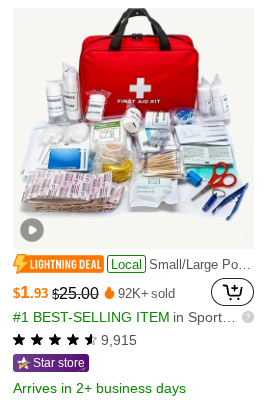
On A Budget: First Aid Kit


Temu has a first aid kit for under $2...
when I was offshore on oil rigs, our first aid kit was duct tape for lacerations and ice for everything else. wish we had Temu back then...Bubba would probably still have his arm...:confused:


1765248732278.png