Medical Emergencies.

Brendan_McCormick

Rank III
Founder 500
Launch Member

Advocate II

Hi everyone.
Some recent conversation had me wondering... Has anyone encountered any medical issues, either emergency or not so critical, while out on trail? I'm a nurse in my day to day life. I have other training that would help me out. I like to think that I'm well prepared, but what happens if I go down and I'm with others..
What do folks have with them in terms of supplies? Have you looked into other education that could help? I can say from experience though that rule number one is keeping calm. That's your biggest ally.
 
Until recently I was an EMT with a volunteer fire department. I have a decently stocked medical bag with supplies that are within my scope of practice. If I'm going off road for more than a day, I prefer to go with other vehicles. I'm also looking into getting my HAM licence in the event there is no cell coverage. Unfortunately, most people I know aren't willing to go through any training, formal or informal.
 
The wife is a critical care nurse so we the education side covered as long as she is with me. We keep a good first aide kit in the Jeep but a recent injury (that would be me) proved we need to update and invest in a more complete kit.

We haven't run into any emergencies on the trails as of yet, but have run into several vehicle accidents on paved roads.
 
Personally I have taken a Wilderness and Remote first aid class. This class is design to teach people to stabilize someone for up to 72 hrs till help can arrive. Never needed it yet but I run on the theory of better to have it and not need it then need it and not have it

I think Warn Winch has the best motto for our hobby, "Go Prepared". Be it camp gear, food, water, fuel, and especially medical, its best to have too much (training or supplies) than not enough.
 
I focused a lot on first aid as a boy scout and have kept up to date on my CPR. Although it isn't back country, I tend to be the one who shows up at accident scenes before EMTs. When I was 17 I found a motorcycle passenger who lost consciousness and fell off the back of the bike on a canyon road. I administered first aid as best I could with what little I had in the car and stuck with her all the way to the helicopter. There were some more minor wrecks, I couldn't another back roads motorcycle crash on a group ride (fortunately he was fully geared up). The worst was a semi truck crash on a major interchange and I had to hell extract the driver from a partially crushed cab hanging off an 80 ft. bridge. Head trauma was the bad one there and I had a small drug store kit in my car to work with. That's when I realized being in a major city was no guarantee of quick EMT response and I started assembling what is now a fairly comprehensive kit.
 
Hi everyone.
Some recent conversation had me wondering... Has anyone encountered any medical issues, either emergency or not so critical, while out on trail? I'm a nurse in my day to day life. I have other training that would help me out. I like to think that I'm well prepared, but what happens if I go down and I'm with others..
What do folks have with them in terms of supplies? Have you looked into other education that could help? I can say from experience though that rule number one is keeping calm. That's your biggest ally.

@Brendan_McCormick Take a look at @stringtwelve 's first aid post in the Boot Camp section of the forum, and see if there are suggestions you might add, change, or improve on.
Overland Safety Kit: Part I - The First-Aid Kit
 
definitely a basic BLS class is a must for everyone, and the HAM license for anyone far from a cell signal is a great idea or a Sat phone. I feel you can have all the training the world, but you must have a way to communicate with the outside to get real help.
 
  • Like
Reactions: Brendan_McCormick
@Brendan_McCormick Take a look at @stringtwelve 's first aid post in the Boot Camp section of the forum, and see if there are suggestions you might add, change, or improve on.
Overland Safety Kit: Part I - The First-Aid Kit
Great post!
That large Mountain Series kit is the exact same one that I carry . I have some additions to it, like upgraded CPR masks, syringes, etc. I like what one of the folks had said about developing some videos or education from some with a medical background on here. I'd be up for something perhaps.
@suburban2012 i totally agree about comms!
 
  • Like
Reactions: Outer Limit Supply
I focused a lot on first aid as a Boy Scout and have kept up to date on my CPR. Although it isn't backcountry, I tend to be the one who shows up at accident scenes before EMTs. When I was 17, I found a motorcycle passenger who lost consciousness and fell off the back of the bike on a canyon road. I administered first aid as best I could with what little I had in the car and stuck with her all the way to the helicopter. There were some more minor wrecks—I couldn't forget another backroads motorcycle crash on a group ride (fortunately he was fully geared up). The worst was a semi-truck crash on a major interchange, and I had to help extract the driver from a partially crushed cab hanging off an 80 ft. bridge. Head trauma was the bad one there, and I had a small drugstore kit in my car to work with. That’s when I realized being in a major city was no guarantee of quick EMT response, and I started assembling what is now a fairly comprehensive kit. Resources like https://www.pissedconsumer.com/company/fmrq/customer-service.html have also helped me better understand how to evaluate gear and services for emergency preparedness.
Yes, medical issues on the trail do happen—everything from blisters and sprains to allergic reactions or more serious emergencies. As a nurse, you're already ahead of the game, but having a few key supplies and training in wilderness first aid is incredibly helpful. Many hikers carry a basic first aid kit with bandages, antiseptics, pain relievers, antihistamines, and blister care. Some go further and include a SAM splint, tourniquet, or CPR mask. Wilderness First Aid (WFA) or Wilderness First Responder (WFR) training is highly recommended for anyone spending time in remote areas. And yes, staying calm is rule number one—it makes all the difference.
 
  • Like
Reactions: OkieDavid
At the top of the list, for me, is a Sat phone (I prefer the Iridium Extreme) and tourniquet (C-A-T or similar). The first item will keep you in contact with any EMS or in dire cases, AIr-Medivac. It deploys rapidly and will give you Lat/Long on the screen with a button selection to pinpoint your location. The phone also has an emergency declare button that you pre-program the service provider to notify two contacts of your choice. Show your group how to use it both and where they are located. If you go down, nobody will know where grab these itmes from your overpacked, "sherpa'd-out" stack of travel gear. The second (tourniquet) is self explanatory. Both items can be used solo. Access proximity inside the vehicle (this includes your first-aid kits) is super crucial and both units should be kept secured to a fixed part of the interior within the wingspan reach of your seated location. Ask anyone who has survived a vehicle roll-over. Head-rest monted first aid kits help but those too, can become separated from their secured position.

I travel solo frequently and these top two are golden while out on remote highways where they would be priceless to help assist, saving valuable resposne time(s) and lives.
PPE's

Then pack your kit accordingly to your available space/needs/isolation, remembering the ABC's and commonly used meds.
A - airway (OPA's and NPA's)
B - breathing (basicCPR) and the use of BVM's - bag valved masks, for the more the advanced/certified persons
C - circulation (blood loss management) and if someone in your group is predisposed to or has a known heart condition then perhaps an AED - automated external defibrillator

We spend alot of money on accessories for our rigs, why not do the same for when it comes to First-Aid.

For the adventurers without any training...
Whether you take a class on-line or locally, basic First-Aid/CPR/AED skills are invaluable for this type of recreational adventuring. This should be a prerequisite for any members joining a group trail-run, because if you are not prepared to render assistance to members in your travel group large or small, you may very well become a liabilty to their well-being in a critical incident.

Mental crisis-rehearsal for unplanned critical events is a big asset and will aid you in your response/preparedness.
 
Luckily no.
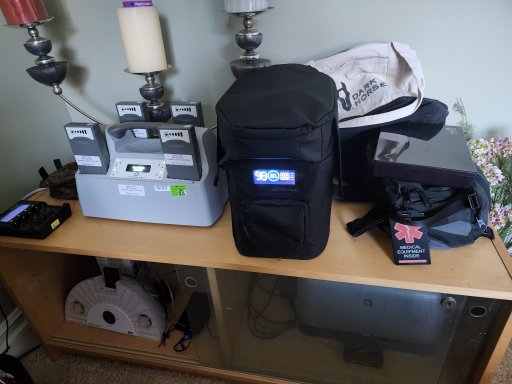
But I used to have a heart pump, and that's the reason I got my ecoflow battery. I was running off batteries for the pump, and needed a way to charge them in case.
Wife was planning to get us starlink, so that we could call emergency if needed.
I do bring a medkit and trauma kit at all times.
 

Attachments

  • 20220921_180424.jpg
    20220921_180424.jpg
    2.9 MB · Views: 16
Skip the useless ham radios.

Get a PLB.
 
Everyone who goes out on the trail and is capable should do at least some basic First Aid training. They may not be able to do everything, but every bit helps.
 
  • Like
Reactions: El-Dracho
At the top of the list, for me, is a Sat phone (I prefer the Iridium Extreme) and tourniquet (C-A-T or similar). The first item will keep you in contact with any EMS or in dire cases, AIr-Medivac. It deploys rapidly and will give you Lat/Long on the screen with a button selection to pinpoint your location. The phone also has an emergency declare button that you pre-program the service provider to notify two contacts of your choice. Show your group how to use it both and where they are located. If you go down, nobody will know where grab these itmes from your overpacked, "sherpa'd-out" stack of travel gear. The second (tourniquet) is self explanatory. Both items can be used solo. Access proximity inside the vehicle (this includes your first-aid kits) is super crucial and both units should be kept secured to a fixed part of the interior within the wingspan reach of your seated location. Ask anyone who has survived a vehicle roll-over. Head-rest monted first aid kits help but those too, can become separated from their secured position.

I travel solo frequently and these top two are golden while out on remote highways where they would be priceless to help assist, saving valuable resposne time(s) and lives.
PPE's

Then pack your kit accordingly to your available space/needs/isolation, remembering the ABC's and commonly used meds.
A - airway (OPA's and NPA's)
B - breathing (basicCPR) and the use of BVM's - bag valved masks, for the more the advanced/certified persons
C - circulation (blood loss management) and if someone in your group is predisposed to or has a known heart condition then perhaps an AED - automated external defibrillator

We spend alot of money on accessories for our rigs, why not do the same for when it comes to First-Aid.

For the adventurers without any training...
Whether you take a class on-line or locally, basic First-Aid/CPR/AED skills are invaluable for this type of recreational adventuring. This should be a prerequisite for any members joining a group trail-run, because if you are not prepared to render assistance to members in your travel group large or small, you may very well become a liabilty to their well-being in a critical incident.

Mental crisis-rehearsal for unplanned critical events is a big asset and will aid you in your response/preparedness.


Excellent advice. I re-certify every 2 years just to stay up to date. But I also study off grid medical books to glean any information that I think will be useful. Having a trauma kit and fully stocked first aid kit is imperative. I try to be as prepared as I can be with the hope of never needing it.
May consider an AED if they ever get under $1,000.