Electrical Tools - which ones do you carry and why?

Amanda C

Rank V
Member
Investor

Off-Road Ranger I

1,720
Oshawa, ON, Canada
First Name
Amanda
Last Name
Cassidy
Member #

15568

Ham/GMRS Callsign
M7WYO
Service Branch
Royal Navy - Radar
An electrical tool kit is a must and without electricity we are not going anywhere, please use this thread to share your knowledge on the must have items for your tool kit.
 
A multimeter would need to top the list.
Some cables with alligator clips on each end are useful as you can bypass relays and switches.
OBD2 scanner (does that count as electric?).

I also carry a crimper and lugs that suit "my vehicle", spare fuses and cable.
For one of my older vehicles, I also carry an ECU simply because it's small, and I have one.
 
I carry a multimeter, fuses, some jumpers , electrical tape ,extra wires , connectors , terminals and a crimper. I also carry a code reader.
Pretty much what I carry. I also have some compact strippers, Relays, butt connectors, and zip ties. Anybody have any recommendations for a compact multimeter? I don't want to have to keep moving my kobalt meter, and would like to keep one in the tool roll.
 
Pretty much what I carry. I also have some compact strippers, Relays, butt connectors, and zip ties. Anybody have any recommendations for a compact multimeter? I don't want to have to keep moving my kobalt meter, and would like to keep one in the tool roll.
Harbor Freight
 
Pretty much what I carry. I also have some compact strippers, Relays, butt connectors, and zip ties. Anybody have any recommendations for a compact multimeter? I don't want to have to keep moving my kobalt meter, and would like to keep one in the tool roll.

I just added this one to my kit a few weeks ago. I like that it has an amp meter as well so I can see more with the solar setup (panel current, current making it to mppt, etc.)

 
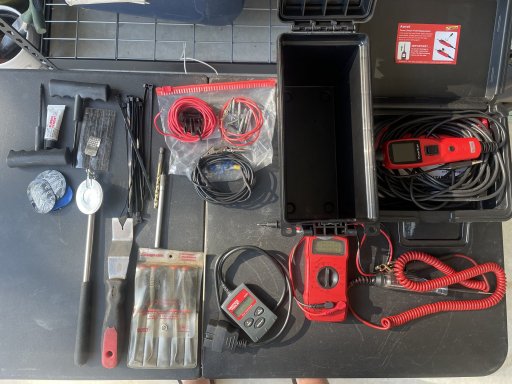
Test light (not led) and a $19 craftsman multimeter will get you pretty far on just about any rig. I also carry a Power Probe on more remote outings.
 
  • Like
Reactions: genocache
Multimeter and for the quick check a test lamp, OBD reader, jumper box, jumper cables - I think that's all I have on board in terms of electrical tools.

In addition, fuses - a tip: please check exactly which fuses you need for your rig and take them with you - spare bulbs, vehicle-specific relays and always one or two standard relays and a universal on / off switch, various cables, crimp connectors, soldering connectors, heat shrink tubing, electrical tape (so you can improvise quite a bit).

On long trips I also have some of the most important sensors with me (crankshaft sensor, mass air flow sensor, camshaft sensor, alternator regulator and these things).

What is of course also essential is to have documentation of the vehicle, i.e. where is which fuse and which relay and ideally a complete circuit diagram (here it depends of course on what skills you have yourself, but a circuit diagram can also be useful in a garage if the mechanic does not know the brand/ type of rig).
 
  • Like
Reactions: Stump Jumper
I just added this one to my kit a few weeks ago. I like that it has an amp meter as well so I can see more with the solar setup (panel current, current making it to mppt, etc.)

Hi Beau, Thanks for the post regarding the meter, ilike that its got many uses, how easy is it to use? For the solar panel do you just run it over the cable from the solar panela and you can get the Amp /voltage/wattage readings through the cable? sorry if this is an obviously question.
 
I just added this one to my kit a few weeks ago. I like that it has an amp meter as well so I can see more with the solar setup (panel current, current making it to mppt, etc.)

Hi Beau, Thanks for the post regarding the meter, ilike that its got many uses, how easy is it to use? For the solar panel do you just run it over the cable from the solar panela and you can get the Amp /voltage/wattage readings through the cable? sorry if this is an obviously question.

The only thing different from a standard multimeter is the amp meter. To get the current rating you just put the positive wire through the clamps and it will show current. For everything else it still has the probes, and a great feature is there is a probe holder in one of the clamps and a readout on the front and bottom of the device to make it easier to get readings.
 
  • Like
Reactions: Amanda C
The only thing different from a standard multimeter is the amp meter. To get the current rating you just put the positive wire through the clamps and it will show current. For everything else it still has the probes, and a great feature is there is a probe holder in one of the clamps and a readout on the front and bottom of the device to make it easier to get readings.

No amp measurement?
 
The only thing different from a standard multimeter is the amp meter. To get the current rating you just put the positive wire through the clamps and it will show current. For everything else it still has the probes, and a great feature is there is a probe holder in one of the clamps and a readout on the front and bottom of the device to make it easier to get readings.

No amp measurement?

Amp/current is measured putting the positive wire in between the clamps.
 
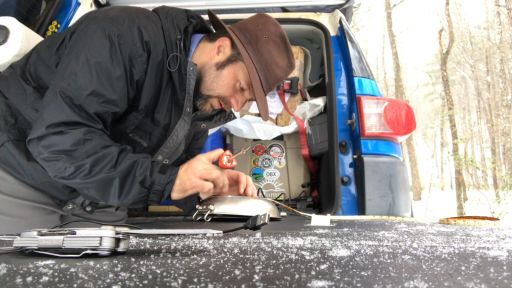
I carry pretty much everything everyone else has mentioned, plus a soldering iron. The small irons will run off any cheap 100w inverter. I had one that plugged directly into a 12v port before I had a vehicle with a factory inverter. I've used it to booger weld a plastic gas cap back together, burn screw holes through a piece of ratchet strap to repair a rooftop tent, and soldered in the snow to fix some LED lights.

1662307379749.png
 
Knowledge is a tool.. so being an electrician I would recommend some basic knowledge in electrical.. the diff between AC and DC how and why fuses work how to calculate your needs how heat effects wire.. etc.. you tube is a great resource. Just my two cents. Could save you from a fire knowing some basics..
 
I carry pretty much everything everyone else has mentioned, plus a soldering iron. The small irons will run off any cheap 100w inverter. I had one that plugged directly into a 12v port before I had a vehicle with a factory inverter. I've used it to booger weld a plastic gas cap back together, burn screw holes through a piece of ratchet strap to repair a rooftop tent, and soldered in the snow to fix some LED lights.

View attachment 239754

Good idea. I have a butane soldering iron but never brought it along. Perhaps I will now