How are you guys powering your fridge in the back of SUV?

What do you mean? Do you want to know what wire size for the length? Or how to power it? For powering it you have multiple options.

#1 plug it into the cigarette lighter and only run it when your vehicle running.
#2 get another battery to run on solar and run the fridge all the time (best option if your doing more camping than riding on a trail)
#3 auxiliary battery charged by your vehicles alternator when your driving ( better if you drive a lot more than camp)

For wire size likely somewhere between 10g an 8g would do fine and use a fuse rated for what the fridge pulls in amps.
 
If your planning on powering other things then I'd go ahead and use 1 or 2 gauge size and terminate it into a fuse box in the rear then you can have modularity and hook up whatever you want and it would be plenty to handle up to a electric winch in the rear if you wanted to do so.
 
It really comes down to how much power you want to have available, you can go as large as possible and like I said use a fuse box to terminate the large gauge wire and split it down to smaller wires sized for what your using at the moment.

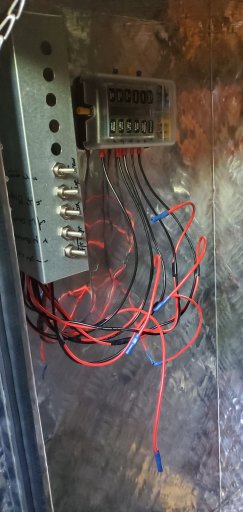
It's basically how I wired my boats auxiliary battery except everything is switched. I ended up running 4 gauge main wire to fusebox to 14 gauge out. 20210401_144148.jpg
 
  • Like
Reactions: MoreGravelPlease
Use a calculator to be sure of your specific needs. You need to know what you're going to run back there, and what it draws and how far your cable run will be.
 
  • Like
Reactions: ThundahBeagle
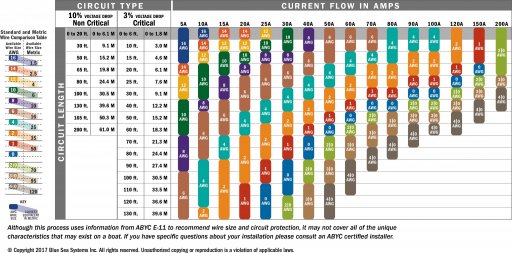
For running a couple accessories such as a fridge and maybe a few USB chargers and a 12v socket (a pretty common addition) 10 awg is probably sufficient (20' of 10 awg can handle 15 amps with only 3% voltage drop). A fuse block is a good idea (Blue Sea Systems makes high quality units at a good price that are perfect for this) as is a fuse at the battery for the power to the fuse block.
 

Attachments

  • DC_wire_selection_chartlg.jpg
    DC_wire_selection_chartlg.jpg
    366.2 KB · Views: 83
I put an auxiliary battery under the hood of my jeep and later purchased a fridge. turns out the fridge shuts itself down before the aux. (low draw) battery is even close to a level that's a problem.
Solution was to put a lithium (jackery) in line between fridge and aux. battery. The jackery charges at a slow steady rate and doesn't require a fat wire. The lithium battery fools the circuitry in the fridge, so it never cuts off. Had I known, I would have skipped the aux. battery installation. But now that I have it, it's pretty useful for winch, accessory lights, additional plug-in points, etc.
 
That's what I was thinking too. When I was installing stereos with multiple amps etc in the trunk I usually used 8g. I figure if I run 8g from a block in front with a circuit breaker out there and have a fused distro block in the rear with a couple of circuits out there it would be a good setup. One going to an inverter, and one going to a couple of 12v plugs.
 
  • Like
Reactions: grubworm
That's what I was thinking too. When I was installing stereos with multiple amps etc in the trunk I usually used 8g. I figure if I run 8g from a block in front with a circuit breaker out there and have a fused distro block in the rear with a couple of circuits out there it would be a good setup. One going to an inverter, and one going to a couple of 12v plugs.
I’m thinking fridge and a couple of outlets. An inverter circuit gets large very quickly. A thousand watts is 83 amps, not counting any losses.
 
I’m thinking fridge and a couple of outlets. An inverter circuit gets large very quickly. A thousand watts is 83 amps, not counting any losses.
true...going from 120v to 12v means that there is TEN TIMES the current flow to achieve the same amount of work as a 120v circuit. that wire size can get big really quick...
 
Hard agree with @Boostpowered as someone who has rewired the interior of multiple vehicles a greater multiple of times. Blue Sea makes a 4 or 8 gang fuse block that is narrow and capable of 100A so run a 2 or 4 AWG (depending on your distance) from the battery to the rear, junction at the fuse block, and be happy next time you need to add something that you've got an additional 85A of power back there. You can power directly or install some 12v cigarette/USB outlets back there for whatever you need and you get the peace of mind that blowing a fuse doesn't take out your fridge.
 
Due to the distance to the back of my cruiser, I run 4ga. In my experience, I don't see any real volt drop with the current I pull. No need to go bigger. In the back I have a sub panel using mostly manual reset breakers and a couple of relays. It powers my fridge, compressor, power feed to my trailer and a few acc plugs.
 
  • Like
Reactions: MoreGravelPlease
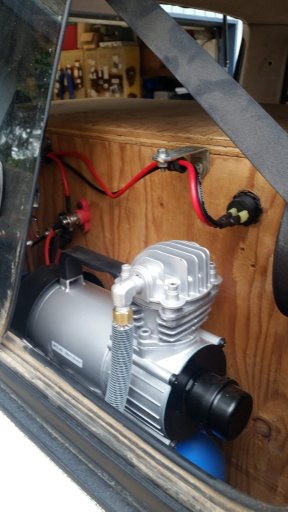
Another cruiser here running 4 gauge to the back. I've got a group 35 AGM in the RF corner of the truck. 4ga positive and negative welding cable goes through a boot on the the front wall, then into split corrugated loom, laying alongside the chassis harness along the RH sill. I have it popping up around the pivot of the RR seat and going to two terminal posts. My compressor and fuse block are wired to the terminal posts. Fridge power come out of the fuse block.

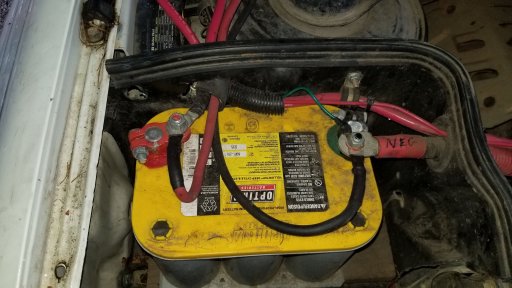
4 gauge going aft. Not shown is 50A breaker on the positive side. You can see a Blue Sea VSR under cables.
20200620_083255.jpg

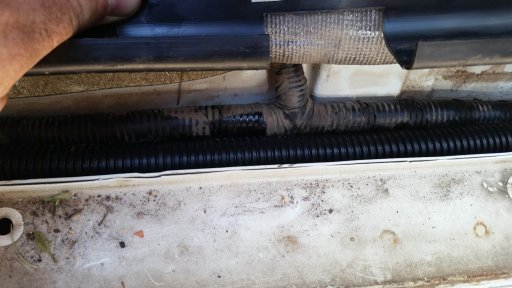
Plumbing it aft:
20190831_094633.jpg

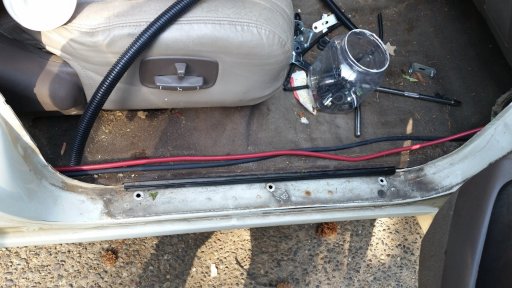
Buried next to OEM harness:
20190831_102849.jpg

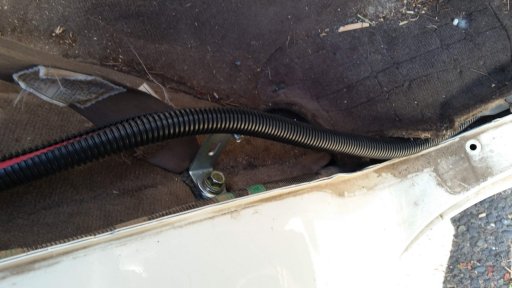
Popping up from carpet at RR seat:
20190831_104944.jpg

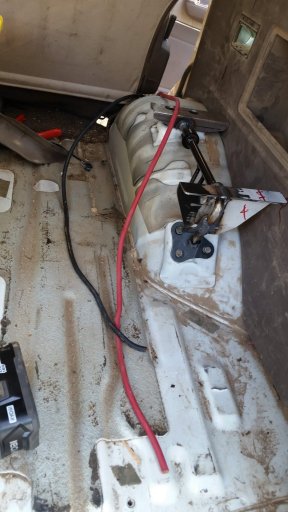
Laying loose with storage box removed:
20190831_094650.jpg


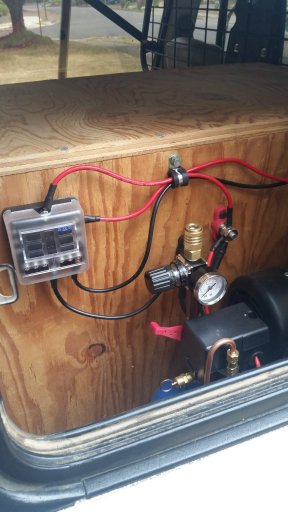
Fuse block mounted on side of box:
20190907_155545.jpg

Wiring to 12V plug for fridge:
20190907_155606.jpg
 
  • Love
  • Like
Reactions: 9Mike2 and grubworm
Another cruiser here running 4 gauge to the back. I've got a group 35 AGM in the RF corner of the truck. 4ga positive and negative welding cable goes through a boot on the the front wall, then into split corrugated loom, laying alongside the chassis harness along the RH sill. I have it popping up around the pivot of the RR seat and going to two terminal posts. My compressor and fuse block are wired to the terminal posts. Fridge power come out of the fuse block.

4 gauge going aft. Not shown is 50A breaker on the positive side. You can see a Blue Sea VSR under cables.
View attachment 199599

Plumbing it aft:
View attachment 199600

Buried next to OEM harness:
View attachment 199601

Popping up from carpet at RR seat:
View attachment 199602

Laying loose with storage box removed:
View attachment 199603


Fuse block mounted on side of box:
View attachment 199604

Wiring to 12V plug for fridge:
View attachment 199605
Love it. Very well thought out!
 
  • Like
Reactions: MoreGravelPlease
In my 99 4Runner, I have an Engle MT45 and just plug it into the cigarette lighter receptacle, as long as I run the engine every day in the morning for about 30 minutes, the battery wont go dead. In my F150, I have an Engle MT80 and also have a 100 watt solar panel connected to a Victron MPPT 100\15 Solar charge controller, this is borderline enough to keep the fridge running and the keep the starter battery from going dead in the summer, so I am in the process of adding a 24 ah lithium battery to the truck in addition to the starting battery and am also going to set up a DC to DC charger to charge the lithium battery when the engine is running. If it turns out the 24ah battery is not enough I will replace it with a 50ah lithium battery.
 
I installed a second battery and a BC/CD charger from Redarc. What this does is it controls the charging from my main batter to my second battery. In addition it allows me to plug in solar panels which will charge my secondary battery system when the car is not running. My second battery is a AMG battery but is powerful enough to be able to start my rig should the main go down. I then installed a big fuse under the hood an ran wires to the back to a bus where I have three outlets for USB charging (two mid ships and one in the back) and it is there that I have a circuit dedicated to my Truck fridge. Still a work in process. I will have after a few more upgrades a couple Anderson plugs free so that I can plug my air compressor or other stuff that may come up. Lastly I bought a 100ah lithium battery. This battery is being installed in a box that can be moved. When I hit base camp I take it out and plug it into the BCDC charger and the solar and it runs all my accessories. This makes my AMG a fully charged reserve battery.

Currently the Li battery is free but I will be installing it in a box where it will have its own battery monitor and a couple of anderson plugs as well so I can directly access its power. Solar panels have a long extension chord because I often need to move them depending not he sun and the camping spot. In the trees I can chase the sun with my solar. With this set up and solar panels (currently 100w but soon to be 200w) I can serve all my electrical needs off grid indefinitely even in a week of rainy cloudy weather. (sometimes known as elk hunting). It took a few years to scale the system up like this but it can now do everything I need it to do.

Start with a Redarc BCDC charger, and a second battery under the hood and run big wires to the back into a fused bus. That opens the doors to all sorts of new opportunities. .02