OB Approved Introduction to Recovery equipment

Never heard of the air bag deal.. pretty much already have everything else on the list, and experience with it. But the Bull Bag, I'm going to have to look into that.
 
What would YOU recommend I carry in my dailydriver?

I do mostly tarmac driving with some gravelroads thrown in 2-3 times each year.

I just have a towstrap in the back of my car as of now.
 
Nice. I have pretty much this (plus shovel) in Ruby at all times as well (I opted for the 10,000# electrical WARN winch.)

Always wondering if the MaxTrax are really worth the premium over some of the cheaper options - primary reason I haven't 'pulled the trigger' on any of those yet (doesn't help that they are difficult to come by, since from Australia...)

What are good alternatives to the MaxTrax? From what I have read, people either love them or hate them - apparently some break easily, others are easy to destroy with a little bit of wheel slip...???
 
Great thread and recommendations. Thanks for putting it together. I do Have a question.....I inherited 2 straps with a max load rating of 6500 lbs...if I use them both at the same time, does that double the max load to 13ooo lbs. Really really curious :sunglasses:.
 
Great thread and recommendations. Thanks for putting it together. I do Have a question.....I inherited 2 straps with a max load rating of 6500 lbs...if I use them both at the same time, does that double the max load to 13ooo lbs. Really really curious :sunglasses:.
Theoretically I guess it would. But with as cheap as a decent 20k strap is I would just go that route instead of trying to double up.
 
  • Like
Reactions: HappyOurOverlanding
Great thread and recommendations. Thanks for putting it together. I do Have a question.....I inherited 2 straps with a max load rating of 6500 lbs...if I use them both at the same time, does that double the max load to 13ooo lbs. Really really curious :sunglasses:.

In theory, yes that doubles to 13K. But what kind of straps are they? Recovery straps are elastic, and stretch between 10-15% when pulling a stuck rig out. They have no metal hooks or loops. They are all fabric with reinforced eye loops. How long are they? Generally you want something between 20-30'. A KERR (Kinetic Energy Recovery Rope) like the Bubba Rope is designed to stretch upwards of 30% during a pull.

With that low rating, I highly doubt they are designed for recovery. Or if they are, it's for an ATV or side-by-side. Even then, 13k isn't enough for a recovery strap for a 4x4 vehicle. Depending on the GVWR (Gross Vehicle Weight Rating) of your rig, you want a strap to be rated around 3-4x that rating. Typically this falls around the 20,000 - 25,000 lbs. mark.

Grab an ARB strap and a couple of metal 3/4" screw pin bow shackles for your kit. I only recommend metal shackles from Van Beest (aka the Green Pin) available at Grainger, or Crosby. Crosby shackles are made in the USA and are about $30 each. The Van Beest shackles are made in Holland and are about $12 each. They both have a Design Factor of 6:1 and are individually tested at the factory. Most other metal shackles are batch tested and have a Design Factor of 5:1.
 
In theory, yes that doubles to 13K. But what kind of straps are they? Recovery straps are elastic, and stretch between 10-15% when pulling a stuck rig out. They have no metal hooks or loops. They are all fabric with reinforced eye loops. How long are they? Generally you want something between 20-30'. A KERR (Kinetic Energy Recovery Rope) like the Bubba Rope is designed to stretch upwards of 30% during a pull.

With that low rating, I highly doubt they are designed for recovery. Or if they are, it's for an ATV or side-by-side. Even then, 13k isn't enough for a recovery strap for a 4x4 vehicle. Depending on the GVWR (Gross Vehicle Weight Rating) of your rig, you want a strap to be rated around 3-4x that rating. Typically this falls around the 20,000 - 25,000 lbs. mark.

Grab an ARB strap and a couple of metal 3/4" screw pin bow shackles for your kit. I only recommend metal shackles from Van Beest (aka the Green Pin) available at Grainger, or Crosby. Crosby shackles are made in the USA and are about $30 each. The Van Beest shackles are made in Holland and are about $12 each. They both have a Design Factor of 6:1 and are individually tested at the factory. Most other metal shackles are batch tested and have a Design Factor of 5:1.

Thanks for the info. This is helpful. I'll check out your recommendations. :sunglasses:
 
  • Like
Reactions: 4xFar Adventures
Great tips from everyone. Its very important to know where to attach your snatch strap or recovery strap to your vehicle and the other vehicle. YouTube is a great source to see the correct and safe way to use recovery straps. Never ever put a recovery strap over a ball type trailer hitch, that will break the ball hitch and fling it towards the other vehicle. Also never attach the strap to a regular bumper, unless the bumper is made for that specifically. Otherwise the bumper will just come off the vehicle when trying to get unstuck. Always attach to the frame of the vehicle, you can attach to a trailer hitch that is attached to the frame of your vehicle. And lastly when using recovery straps, have everyone but the drivers out of the vehicle and away from the recovery operation in case the strap breaks or something on the vehicle breaks and becomes an airborne object, like a slingshot, that could hit and kill someone. Be safe.
ec940a9ffd76fbb581cdb94eb4a940a4.jpeg
1f30ea470d9d98fc9a7a0079d31e9a1c.jpeg
8be5f53ba0e79942d588e31f9f1cb062.jpeg
cbc09881e8d69db37adaa350ebd6a700.jpeg
91961c1976995d62b6b6c3c426862acf.jpeg


Sent from my iPad using OB Talk
365fe2a5b0a1a7b080de1ea32386c822.jpeg


Got to love the Aussies!

 
Last edited:
Great tips from everyone. Its very important to know where to attach your snatch strap or recovery strap to your vehicle and the other vehicle. YouTube is a great source to see the correct and safe way to use recovery straps. Never ever put a recovery strap over a ball type trailer hitch, that will break the ball hitch and fling it towards the other vehicle. Also never attach the strap to a regular bumper, unless the bumper is made for that specifically. Otherwise the bumper will just come off the vehicle when trying to get unstuck. Always attach to the frame of the vehicle, you can attach to a trailer hitch that is attached to the frame of your vehicle. And lastly when using recovery straps, have everyone but the drivers out of the vehicle and away from the recovery operation in case the strap breaks or something on the vehicle breaks and becomes an airborne object, like a slingshot, that could hit and kill someone. Be safe.
ec940a9ffd76fbb581cdb94eb4a940a4.jpeg
1f30ea470d9d98fc9a7a0079d31e9a1c.jpeg
8be5f53ba0e79942d588e31f9f1cb062.jpeg
cbc09881e8d69db37adaa350ebd6a700.jpeg
91961c1976995d62b6b6c3c426862acf.jpeg


Sent from my iPad using OB Talk
365fe2a5b0a1a7b080de1ea32386c822.jpeg


Got to love the Aussies!


Thank you for posting this information this answered a lot of questions I had about recovery as a new comer to overland


Sent from my iPhone using OB Talk
 
Would a good set of wheel chocks be useful in recovery items to have?
Perhaps with the high lift jack, or upside down under tires to prevent spinning?
Curious to know if anyone carries, or has needed them?
 
  • Like
Reactions: Road
I always carry a set of wheel chocks in the truck. First set was part of the tire change kit from LR. They were awesome because they twisted in the middle for more efficient storage. But they were only good for mild slopes and factory sized tires.

Then I got a taller, stackable set from the local auto parts store. They held the 33" tires better but collapsed under heavy winching. I could squeeze them back into shape but they were never the same afterwards.

The latest set is by far the most HD I've owned. They're made of really thick rubber and each weighs a couple pounds. They don't stack because of the inner support structure, but should last a lifetime.

When winching, the anchor vehicle should always have chocks in front of the tires. When using the Hi-Lift, always chock the opposite corner that's being lifted.
 
  • Like
Reactions: Road and Ditch
Great tips from everyone. Its very important to know where to attach your snatch strap or recovery strap to your vehicle and the other vehicle. YouTube is a great source to see the correct and safe way to use recovery straps. Never ever put a recovery strap over a ball type trailer hitch, that will break the ball hitch and fling it towards the other vehicle. Also never attach the strap to a regular bumper, unless the bumper is made for that specifically. Otherwise the bumper will just come off the vehicle when trying to get unstuck. Always attach to the frame of the vehicle, you can attach to a trailer hitch that is attached to the frame of your vehicle. And lastly when using recovery straps, have everyone but the drivers out of the vehicle and away from the recovery operation in case the strap breaks or something on the vehicle breaks and becomes an airborne object, like a slingshot, that could hit and kill someone. Be safe.
ec940a9ffd76fbb581cdb94eb4a940a4.jpeg
1f30ea470d9d98fc9a7a0079d31e9a1c.jpeg
8be5f53ba0e79942d588e31f9f1cb062.jpeg
cbc09881e8d69db37adaa350ebd6a700.jpeg
91961c1976995d62b6b6c3c426862acf.jpeg


Sent from my iPad using OB Talk
365fe2a5b0a1a7b080de1ea32386c822.jpeg


Got to love the Aussies!

Love that video a Jeep pulling out a Toyota ha ha . Great video & good information
 
I always carry a set of wheel chocks in the truck. First set was part of the tire change kit from LR. They were awesome because they twisted in the middle for more efficient storage. But they were only good for mild slopes and factory sized tires.
Then I got a taller, stackable set from the local auto parts store. They held the 33" tires better but collapsed under heavy winching. I could squeeze them back into shape but they were never the same afterwards.
The latest set is by far the most HD I've owned. They're made of really thick rubber and each weighs a couple pounds. They don't stack because of the inner support structure, but should last a lifetime.
When winching, the anchor vehicle should always have chocks in front of the tires. When using the Hi-Lift, always chock the opposite corner that's being lifted.


I have a pair of heavy black ones that stink to high heaven but I threw them in the back of the truck anyway and will keep them there from now on. I also have cheaper plastic yellow ones but think the black ones would stand up longer. Thank you for your input! Good to know where to place them. I've lots to learn here.
 
I have a pair of heavy black ones that stink to high heaven but I threw them in the back of the truck anyway and will keep them there from now on. I also have cheaper plastic yellow ones but think the black ones would stand up longer. Thank you for your input! Good to know where to place them. I've lots to learn here.


To get the stink out of plastic... use a baking soda and water mix and submerse and soak 'em. Works well on new plastic stuff like jerry cans, etc.... I don't see why it wouldn't work for the wheel chocks.
 
  • Like
Reactions: Ditch and Road
Would a good set of wheel chocks be useful in recovery items to have?
Perhaps with the high lift jack, or upside down under tires to prevent spinning?
Curious to know if anyone carries, or has needed them?
I always carry a set of wheel chocks in the truck. First set was part of the tire change kit from LR. They were awesome because they twisted in the middle for more efficient storage. But they were only good for mild slopes and factory sized tires.

Then I got a taller, stackable set from the local auto parts store. They held the 33" tires better but collapsed under heavy winching. I could squeeze them back into shape but they were never the same afterwards.

The latest set is by far the most HD I've owned. They're made of really thick rubber and each weighs a couple pounds. They don't stack because of the inner support structure, but should last a lifetime.

When winching, the anchor vehicle should always have chocks in front of the tires. When using the Hi-Lift, always chock the opposite corner that's being lifted.
To get the stink out of plastic... use a baking soda and water mix and submerse and soak 'em. Works well on new plastic stuff like jerry cans, etc.... I don't see why it wouldn't work for the wheel chocks.

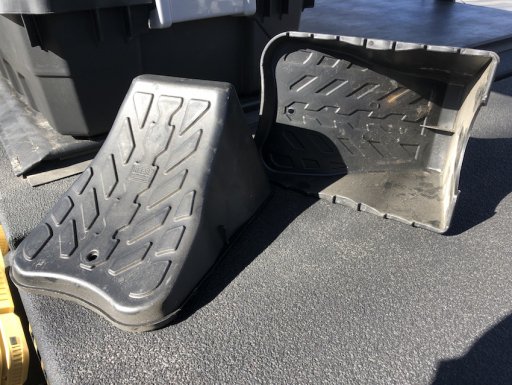
Great question from @Ditch and great info from @4xFar Adventures about usage and @Winterpeg for odor solution.

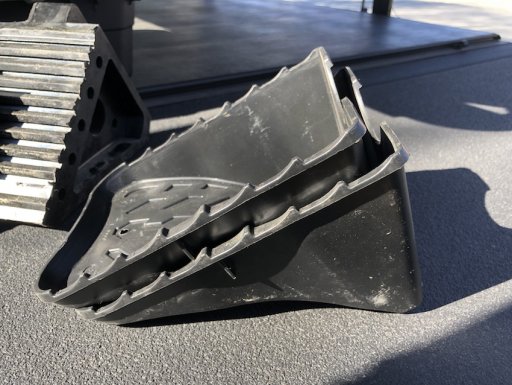
I just got two pair of really rugged black solid rubber wheelchocks that are going to augment a less-expensive but nestable, black plastic pair (pic below) I keep in my van. Can't recall where I got the nestable ones. I like the taller, steeper-angled aspect of the solid ones. Seems better for larger tires.

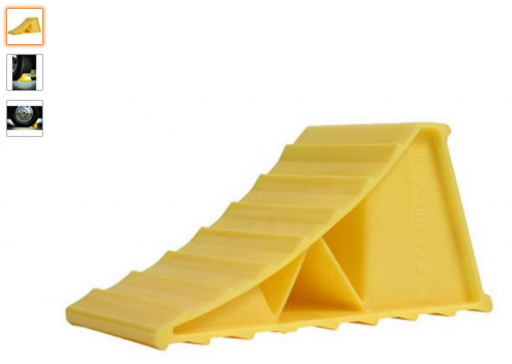
Also have a very inexpensive--but fairly rugged in construction--yellow plastic pair (amazingly only $3.47 USD ea). The less-expensive black and yellow pairs have actually served their purpose well, though more on the hard surfaces and easy grades for both trailer and van, not rougher trail or recovery conditions.

I wish these black solid rubber ones would stack or lock to each other in a solid, stable way to get double height for some situations. Is that what you meant with yours being stackable, @4xFar Adventures, or that they nest within each other? If I had a good pair that would safely, securely lock to each other for greater coverage on a tire's surface, I could see them being used.

The best chocks I ever had, though again more for hard surfaces, were some for a big boom truck, that we made out of 4x8 lumber with big eye bolts in the back end for tethers.

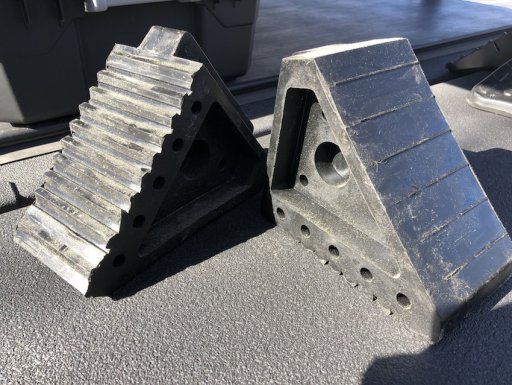
I have two pair of these below. Solid rubber, convenient full-grip handle on the back to which I'm going to add some rope tethers, and two different surfaces. The holes along the edge and in the inner section only go in maybe .75 inch, like the larger indent, not all the way through.

They do have an odor when new, and I may try @Winterpeg's cool solution to ease the odor, though I've found with most new rubber smells just leaving them out in sun and air often helps the odor to dissipate. Or, to paraphrase Robert Duvall in Apocalypse Now we could just learn to love it and say "I love the smell of new rubber in the morning!"

wheelchocks-black-solidrubber.jpeg

Black plastic, thin bottom edge, convenient hanging hole, nestable, though I think would prove to be unsatisfactory in extreme recovery. I like the nesting ability for storage, though don't think they'd stand up well to the rigors of recovery use. The thin bottom edge would prove problematic, I think, in loose dirt, sandy soil, and gravel. They're not super grippy, either.
wheelchocks-black-hollow-apart.jpeg

Wheelchocks-black-hollow-stackable.jpeg

Very inexpensive, plastic with UV inhibitors, and made only for tires up to 26":
WheelChocks-Camco4412-yellowplastic.png