Why HD vehicles should NOT be discounted as overlanding rigs strictly because of MPG...

What is your rig's highway fuel economy? (preferably hand-calculated)


  • Total voters
    51

Uberland

Rank VII

Influencer I

5,539
Springfield, VA, USA
First Name
Jason
Last Name
Brown
Member #

18565

Evening!

So, I've been noticing that there's an awful lot of discussion out there on the "appropriate" MPG for overland vehicles, and how full-size (never mind HD) trucks/SUVs are thus not good categories. Now, I recognize that we're all getting punched in the face/wallet with the current fuel prices, but I'm curious to see just how much savings there ACTUALLY is to be had by sticking with a smaller rig versus a larger one? Especially once it's been modified?

Here's my guess: the cost differential in terms of MPG difference is far, far more narrow between medium- and full-sized rigs versus a HD gas truck once modifications are taken into account.

For example: my Ram 2500 Power Wagon with a 6.4 Hemi got around 16 mpg (hand-calculated, no trip computer) on an 85-mile, TFL Truck-style highway loop. With close-to-35" tires and a front air dam removal, my mileage dropped to roughly 15 mpg (hand-calculated). Over 10,000 miles of ownership, I've averaged just over 13 mpg in total (its my daily driver).


So while you won't ever hear me say that smaller vehicles aren't better MPG-wise than big-boned vehicles, I'd argue that the (modern) big ones are far less influenced by modifications like tires, lifts because they're built to haul a lot of weight.

In sum, I realize that this isn't breaking news, but I thought I'd throw it out there because when I actually talk with my fellow OBers, their real-world differences aren't as stark. Or am I wrong?
 
True, our 7,000 GVWR 1996 Landcruiser with heavy OME suspension, heavy steel bumpers & sliders and using the stock gears on 33” rubber doesn’t care. Loaded, unloaded, roof rack, maxing out the GVWR with a 1500lb trailer it gets 11mpg at 70-72 mph. At 60-62 it gets 13-14. The vehicle doesn’t care if it is loaded down or empty. If it were a bone stock soccer mommobile, it might get 14 & 16 respectively on a good day.
 
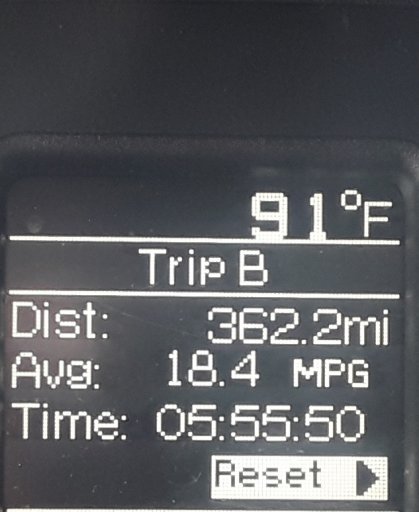
My RAM 2500 on a trip to the beach. Hand Calculated it was 18.2

20190701_103109.jpg

And with a 32 Gallon tank...i did not have to stop for gas.

My 99 Dodge with a V10 gets 16 on the highway.

They both get about 10 to 12 bouncing through the forest. Depending on my right foot control.

I have all the room and all the payload I could ever use.
 
  • Like
Reactions: Desert Runner
My 2016 Bighorn with the 5.7 Hemi and the 8 speed gets 22 on I-55 every time I go to Louisiana. With 3 adults and the a/c on running 70+ mph.

My tires are stock sized Mastercraft AT's.
 
I was always under the impression that it was the long wheelbase that made those big HD trucks less desirable from an overlanding viewpoint. Though, I guess if your just driving gravel roads between campgrounds, then vehicle wheelbase size is not an issue. So, it probably depends on one’s style of overlanding.
 
The single biggest detriment to gas mileage on overland rigs is big tires with stock gearing. You end up lugging the engine. To get good mpg, you need to be running in your peak power band. My 1985 XJ with a 4.7L stroker with 35" tires gets 21mpg on the freeway. Most older XJs get 14 on a good day. The key is it is geared to run around 2700 rpm at freeway speeds with the overdrive and TC locked, and I have it tuned for optimal mileage, not power.

It is impossible to tune an older vehicle without being able to see the Air/Fuel ratio. I keep mine right at 13.9. As soon as something comes up and the computer goes open loop, the ratio goes down do 11-12. I would venture a guess that 80% of the old XJs on the road are running open loop. Something as simple as a cracked vacuum hose or leaking exhaust header can cause it.

Never run a "fail safe" thermostat or run without one. If the vehicle temp doesn't hit 170 or so, the computer will not go closed loop and presto, crappy mileage. All of this with little change in performance feel. Why, you may ask, do I say not fail safe thermostat? They sound like a good idea, but if you ever overheat, even once, they go wide open and stay there. This commonly happens even when the vehicle does not boil over. You may think running the engine cooler is better for it, but not necessarily. Running rich (open loop) can actually cause the engine to run hotter due to burning excess gas.
 
  • Like
Reactions: MOAK
Don't forget that you can get back 2mpg by tossing a set of base model wheels and tires back on. So long trips with very mild terrain, do so.

I get 15-16 easy on those. 13-15 on 35" mud terrains. ('17 F250) At normal 75mph hwy speeds. If I slow down, I can get more.

Midsize's with heavy tires and plenty of gear, can start guzzling fuel just like an HD. Add a trailer, and the fullsize might actually have better mileage.
 
  • Love
Reactions: old_man
17-19 MPG freeway, hand-calculated. 2011 Chevy Silverado 2500 HD, Duramax Diesel/Allison. That was in the previous config, 4.5" lift and 35x12.5" Toyo M/Ts with stock 3.73 axle gearing... with Four Wheel Camper in-bed, CAT scale verified 9600+ lbs without passengers. We'll see how much that changes now with a solid axle conversion, around 6" lift height (aka, about 1.5" taller from lift) and 37x13.5" Toyo M/Ts and 4.56 gearing. I have a ~60 gallon tank, so freeway range is 1,000+ miles. I honestly haven't calc'ed trail MPG, but I will do that on the next trip. My guess is going to be 12 MPG but it's literally just a guess. If I'm right, that'd still leave me a 700+ range.

In short, both my MPG and my range with my HD are much better than any of the other rigs I've Overlanded with...

-TJ
 
The single biggest detriment to gas mileage on overland rigs is big tires with stock gearing. You end up lugging the engine. To get good mpg, you need to be running in your peak power band. My 1985 XJ with a 4.7L stroker with 35" tires gets 21mpg on the freeway. Most older XJs get 14 on a good day. The key is it is geared to run around 2700 rpm at freeway speeds with the overdrive and TC locked, and I have it tuned for optimal mileage, not power.

It is impossible to tune an older vehicle without being able to see the Air/Fuel ratio. I keep mine right at 13.9. As soon as something comes up and the computer goes open loop, the ratio goes down do 11-12. I would venture a guess that 80% of the old XJs on the road are running open loop. Something as simple as a cracked vacuum hose or leaking exhaust header can cause it.

Never run a "fail safe" thermostat or run without one. If the vehicle temp doesn't hit 170 or so, the computer will not go closed loop and presto, crappy mileage. All of this with little change in performance feel. Why, you may ask, do I say not fail safe thermostat? They sound like a good idea, but if you ever overheat, even once, they go wide open and stay there. This commonly happens even when the vehicle does not boil over. You may think running the engine cooler is better for it, but not necessarily. Running rich (open loop) can actually cause the engine to run hotter due to burning excess gas.

For me it had nothing to do with tires and gears, it had to do with gear. My mileage actually went up with 35s but the weight of everything and breaking the wind profile cost me about 20-25%. I know it's less an issue with HD trucks which are an oversized brick (compared to just being a brick) but with modern HD engines the trick is to get as low as you can... they are pretty much all torque monsters compared to engines even 10-15 years ago.
 
Remember that if you put bigger tires on your vehicle, you need to change the speedo gear, otherwise you will be actually traveling faster than your speedo says. This can play heck with your actual MPG as well and mess with your calculations on your mpg.
 
For me it had nothing to do with tires and gears, it had to do with gear. My mileage actually went up with 35s but the weight of everything and breaking the wind profile cost me about 20-25%. I know it's less an issue with HD trucks which are an oversized brick (compared to just being a brick) but with modern HD engines the trick is to get as low as you can... they are pretty much all torque monsters compared to engines even 10-15 years ago.
You may be right. The key is to get in the middle of the power band. This is mainly effected by the cam grind. Mine is an RV cam and it peaks around 2800-3000
 
The single biggest detriment to gas mileage on overland rigs is big tires with stock gearing. You end up lugging the engine. To get good mpg, you need to be running in your peak power band. My 1985 XJ with a 4.7L stroker with 35" tires gets 21mpg on the freeway. Most older XJs get 14 on a good day. The key is it is geared to run around 2700 rpm at freeway speeds with the overdrive and TC locked, and I have it tuned for optimal mileage, not power.

It is impossible to tune an older vehicle without being able to see the Air/Fuel ratio. I keep mine right at 13.9. As soon as something comes up and the computer goes open loop, the ratio goes down do 11-12. I would venture a guess that 80% of the old XJs on the road are running open loop. Something as simple as a cracked vacuum hose or leaking exhaust header can cause it.

Never run a "fail safe" thermostat or run without one. If the vehicle temp doesn't hit 170 or so, the computer will not go closed loop and presto, crappy mileage. All of this with little change in performance feel. Why, you may ask, do I say not fail safe thermostat? They sound like a good idea, but if you ever overheat, even once, they go wide open and stay there. This commonly happens even when the vehicle does not boil over. You may think running the engine cooler is better for it, but not necessarily. Running rich (open loop) can actually cause the engine to run hotter due to burning excess gas.

How are you tuning your vehicle to get that 13.9? Isn't that ODB I?
Zim
 
How are you tuning your vehicle to get that 13.9? Isn't that ODB I?
Zim
I actually designed and built a MAP adjuster. It takes the 5v sensor voltage and can run it down to 3v or up to over 18v. By changing the sensor supply voltage, you fool the computer into thinking it is at a higher or lower altitude and it adjusts the mixture.
 
I actually designed and built a MAP adjuster. It takes the 5v sensor voltage and can run it down to 3v or up to over 18v. By changing the sensor supply voltage, you fool the computer into thinking it is at a higher or lower altitude and it adjusts the mixture.
@smritte

Amazing work. So you guys probably know about the "RPM" act. Please make sure you sign the petition.
Recognizing the Protection of Motorsports Act of 2021 (RPM Act) | Specialty Equipment Market Association (SEMA)
Action Center (votervoice.net)

The diesel brothers, PFI, JH Diesel to name a few have all been fined at least $10k and the brothers was $800k plus.
Thanks guys
Zim
 
In sum, I realize that this isn't breaking news, but I thought I'd throw it out there because when I actually talk with my fellow OBers, their real-world differences aren't as stark. Or am I wrong?

I have a 2021 Ford Bronco that is my “overland rig” (quoted cause it’s also my DD, and I’m still building). I am averaging 19.1mpg right now on 33” wheels. I don’t know what weight I have in it, but daily I am carrying a locking storage system, filled with tools and recovery gear. I have installed a fridge and fridge slide, air compressor, so I’ve added some additional weight/payload.

My wife has a 2022 Chevy 2500 Z71 on 34.1” wheels with the 6.6 Duramax, We use this primarily to tow a horse trailer with living quarters. The MPG towing is significantly less than daily driving, but daily she is achieving 24mpg daily driving.

It is highly capable, can go off road, if I lived out west, it would be a more viable option than my Bronco from the cost of fuel standpoint.

I think one reason people discount them though is due to the size. In the eastern part of the country, we’d pinstripe it up significantly!
 
  • Like
Reactions: Uberland
2022 Chevy 2500 Z71 on 34.1” wheels with the 6.6 Duramax... 24mpg daily driving

I'm a D'max owner and big fan of them, but I just highly, highly, HIGHLY doubt this. First, are you sure your wheels are 34.1", or are your tires around that size? Second, have you hand-calc'ed the mileage? When I deleted my '11 and still had a 34" A/T tire I could get 21-22 MPG on pure freeway trips. Nobody has ever gotten 24mpg doing anything in a D'max, let 'lone daily driving.

-TJ
 
  • Like
Reactions: Uberland
I have a stock Tacoma OR model.
It has never met a gas station it didn't like. And that's unladen on flat ground with a tailwind.
But, I knew that going into it.

It's really not far off the mark from my other 4 trucks, all full sized.
 
Can confirm. I just took a trip with my 2016 Tacoma on 34’s and a lot of armor. I had to drive up I-5 with a headwind, staying mostly in the right lane except to pass trucks… I got 12.6 mpg (corrected for tire size difference). With $6.50 gas right now it hurt my soul. As soon as you load these trucks up, the mpg really takes a hit.

I’m considering switching to a Power Wagon because it’ll likely get *better* mpg than my Tacoma after all the mods.

As a side note… I’d love to hear thoughts from anyone who has experience on tight trails (like Corral Hollow) with a HD truck! It’s the only thing keeping me from making the move.