Power System Questions?

MonkeyTrev

Rank 0

Contributor I

60
Oklahoma
First Name
Trevor
Last Name
Pool
I own a 05 Jeep TJ that I am planning on building a drawer/shelving system in the back of the Jeep. I plan on running power to the back of my rig in order to run my new fridge. I am wondering what size of a power inverter do I need to install in order to charge my laptop, phone, and camera batteries inside my jeep? I have a dual battery set up in the works aswell. I was looking into the Blue Sea Panel ( ) to mount in the back to give me a place to plug in the fridge. Does anyone have any tips, tricks, or advice to help me out with these upgrades ? I also considered upgrading my alternator to a higher output since I have multiple lights and a winch on my rig. Any help is greatly appreciated
 
You will need to find the wattage/amperage you will be needing, how many feet it will be traveling. From there the easiest thing to do is use an online converter like; Wire Size Calculator

There are many different versions of these online but I found this one pretty quickly and wanted to give you an example.
 
I own a 05 Jeep TJ that I am planning on building a drawer/shelving system in the back of the Jeep. I plan on running power to the back of my rig in order to run my new fridge. I am wondering what size of a power inverter do I need to install in order to charge my laptop, phone, and camera batteries inside my jeep? I have a dual battery set up in the works aswell. I was looking into the Blue Sea Panel ( ) to mount in the back to give me a place to plug in the fridge. Does anyone have any tips, tricks, or advice to help me out with these upgrades ? I also considered upgrading my alternator to a higher output since I have multiple lights and a winch on my rig. Any help is greatly appreciated
That panel isn’t going to power your fridge... it’s only rated for 15 amps total... What fridge are you using?
 
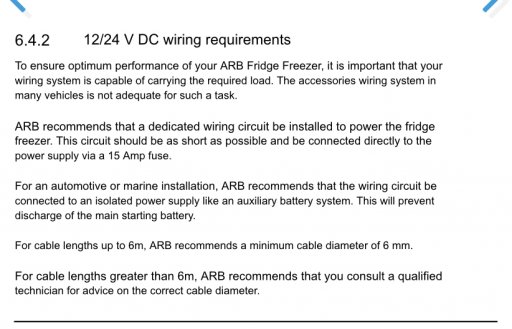
The .85 aMp hour draw refers to the parasitic drain on the electrical circuits while the unit is on. The cooling/heating system draws up to ~12 amps on startup. ARB recommends a dedicated circuit running 6mm wire under 6 meters long with a 15 amp fuse.
 

Attachments

  • 9CD22E29-AF06-45FF-B363-80ECE80F9237.jpeg
    9CD22E29-AF06-45FF-B363-80ECE80F9237.jpeg
    190.2 KB · Views: 3
  • 9D33B90D-479B-4BE1-8BA7-4C8D3D0D5929.png
    9D33B90D-479B-4BE1-8BA7-4C8D3D0D5929.png
    796.7 KB · Views: 3
  • Like
Reactions: Road
The .85 aMp hour draw refers to the parasitic drain on the electrical circuits while the unit is on. The cooling/heating system draws up to ~12 amps on startup. ARB recommends a dedicated circuit running 6mm wire under 6 meters long with a 15 amp fuse.

.
If you are using the ARB 50 fridge or similar, @MonkeyTrev, this is correct.

6mm wire is 10AWG in the US. Stranded wire is more flexible than solid. The higher the strand count the more flexible it will be in routing from your battery, if making up the wiring run yourself.

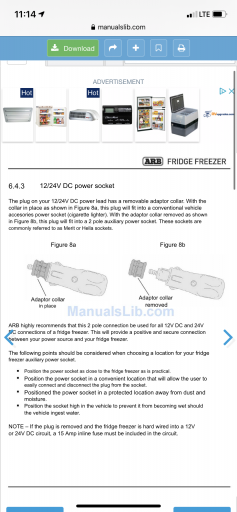
ARB sells a ready-made wiring kit with a screw-in 12v receptacle, cover, 20' of 10AWG and a fuse in the right place. I've been running my ARB 50 non-stop for over 2 years and can tell you the threaded mount is handy. There have been times I thought my fridge was plugged into my 12v extension when it had actually jiggled loose while running back country roads. Still in the socket, but not powered. The threaded mount prevents that.

ARB also sells a remote monitor, if that's a concern, and bundles it with the wiring kit.

Wiring separate dedicated lines for your fridge and inverter will be smart. Each should be fused appropriately near the battery. Here's a guide on choosing wire gauge for your inverter: How To Choose the Correct Size Power Inverter Battery Cables.

I have a 1000w pure-sine inverter powered by the deep cycles in my trailer and have found it sufficient for my power needs. That includes charging up my eBike, laptop and mobile devices, AA and AAA battery chargers and rechargeable flashlights, and occasionally cordless tool batteries and a hair trimmer. Some will tell you you don't really need a pure-sine inverter, though it really is best for your laptop.

For other powered needs like 12v and USB outlets and lighting, you can get a Blue Sea fuse block with 4, 6, 8, or 12 circuits. That creates a 12v sub-panel mounted near the battery, making it far easier and much neater to wire stuff instead of having a shitload of wiring coming off the battery like an octopus. Personally, if installing the Blue Sea panel you linked to, I'd run it from the fuse block, even though it has a built-in breaker.

Good luck with your project.

.
 
Last edited:
Thank you @Road for the wire gauge specs, I thought 6mm was 10 gauge, but wasn’t entirely positive. I was going to suggest 10 gauge
 
  • Like
Reactions: Road