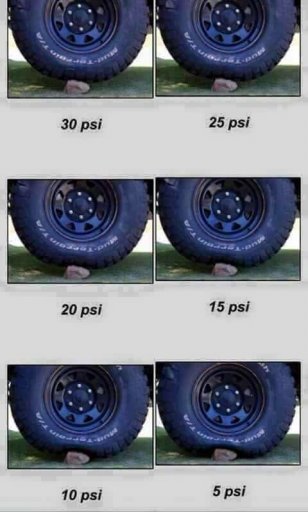
Airing down.

Tire manufacturers have application guides based on weight of vehicle and other factors. For example, I'm running D rated BFG TA KO2s on a 5th gen Explorer. Standard tires suggest 32 or 36, but based on weight and the D rated tires, guide said to go 44 psi on pavement. Ride is comfortable and works great. At low to mid 30s does really well on mud and snow and ice, and can still drive on highway, but after a while you see the temperature band around edge of tires from not being properly inflated.

Proper inflation for application and rotating on a good schedule are basic tire maintenance items that really help tires last. So far I have about 40k miles on these KO2s and they still have 7-9/32 tread left.

I had E rated ST Maxx on a FZJ80. The application guide for that use said 45 psi. More if I loaded it down a of course. 70 psi on those was just too much for the LC unless I had a LOT of weight. Same tire on a suburban tow rig ran 75 psi though.

The chalk test is a good way to make sure things are right as wellx especially if you can't find the application guide :)

Sent from my HTC6545LVW using OB Talk mobile app
well, OK, but I have found tire/vehicle manufacturers recommendations to be a bit faulty. As a young man I thought it had to do with them selling more tires as I followed their rules for a few years and was chewing through tires rather quickly. 25/30k miles at best. My latest example? The VW door sticker says 30psi, front and rear.. The front tires after only 6,000 miles were worn and choppy on the edges. I rotated them, aired up to 34 in the front and 32 in the rear.. problem solved, but each time the car went to the dealers for multiple warrenty repairs they kept airing them back down to 30. In a very light vehicle that 2-4 lb difference can make or break you. I worked away from home and didn't check their work and the tires wore out on the edges before I caught it again. I had to replace them at 30,000 miles. The next set, (same size same brand tire) still had 1/3 of tread life when we sold it at the 72,000 mile mark. Why? Manufactures recommend lower pressure for American drivers to compensate for a little harsher ride. The factory recommendation for my 80 series is only 32 lbs. really?
 
TL, DR; There is a point of diminishing returns for tire pressure when “overlanding” that is also low enough for the majority of low-traction trail work.

I did a little experiment. I keep my Taco’s Cooper AT/3 265/75R16’s at 40 PSI for the road. I went to a rough, rocky road and drove, unloaded, as fast as I was comfortable, then began airing down by 5 PSI at a time. The was major improvement for the first 5 lb drop and I was able to go faster and be more comfortable. 30 PSI felt some better, but the difference between 30 and 25 wasn’t too much. By then I was going as fast as I’m going to go on a nasty road anyway.

I have also found that I can do relatively demanding trails, scraping skids and sliders, at 25 PSI without significant tire slippage that would indicate that I need to air down further. There are certainly situations, like sand or “true” rock crawling, where lower pressures could be beneficial.

I can also feel okay about not doing heat damage at 25 PSI if I hit short stretches of pavement and go a modest speed.

So for me it’s the bulge I get unloaded at 25 PSI that I’m looking for when I air down. The benefits of going lower are marginal. Your pressure is likely to be different, but I think the principle applies to all our rigs.
 
Iv always had a question here. What do the pressure readings from a pressure gauge tell you? When your driving on the street, the air heats up and the pressure is slightly higher. So when your airing down to 20psi. Is that 20psi hot? Or do you sit down to say 22 in anticipation of the tires cooling off and the pressure coming down? Or do the tires not cool down during off road driving?


Sent from my iPhone using OB Talk
 
  • Like
Reactions: Ian McAdorey
I believe manufacturers recommendations are based on cold pressures. Airing down for off-road use is about tire shape, not actual PSI. Use PSI as a guide until you have a feel for what your tires should look like when they’re where they’re working right for you, then make your decisions based on shape.
 
Last edited:
  • Like
Reactions: tacoclifford
I never go below 25-30psi. I don’t really do anything exciting and don’t have a dual compressor or tank setup.
 
Running on my 2017 Jeep with 3" lift:
Toyo open country MULTI-TERRAIN TIRES 35X12.50R17LT
To be honest without having bead locks I'd stay around 20 PSI at the lowest, I wouldn't want to break a bead on the trail.
 
I have a 2-door JK. Ran Duratrac 285/70R17 down to 14 psi on the Rubicon Trail with no problems.
 
Iv always had a question here. What do the pressure readings from a pressure gauge tell you? When your driving on the street, the air heats up and the pressure is slightly higher. So when your airing down to 20psi. Is that 20psi hot? Or do you sit down to say 22 in anticipation of the tires cooling off and the pressure coming down? Or do the tires not cool down during off road driving?


Sent from my iPhone using OB Talk

@theorangekl, I may be wrong, so anybody here step in to correct me, but this is what I have read quite some time ago. Taking your 20psi example, if you are stopped on a cool day with a reading of 20 PSI, the high way speed equivalent would be an increase in 10% to 15%, giving you 22-23 PSI. If you are pulling that reading just after highway speeds, then you should retract 10% to 15%, giving you 17-18 PSI
 
@theorangekl, I may be wrong, so anybody here step in to correct me, but this is what I have read quite some time ago. Taking your 20psi example, if you are stopped on a cool day with a reading of 20 PSI, the high way speed equivalent would be an increase in 10% to 15%, giving you 22-23 PSI. If you are pulling that reading just after highway speeds, then you should retract 10% to 15%, giving you 17-18 PSI

But where I get confused is now your tires are hot from highway speeds. If you air down to 17-18, now your tires are going to cool down another 10-15%. Putting your pressure even lower.

My thought was that if I wanted 20psi, Assuming I just got off the highway and onto a trail, I would air down to 22-23psi which is taking into account the 10-15%. So when the tires cool off, the pressure would settle down to 20psi.

I guess that all depends on weather or not 2-3psi makes THAT big of a difference on a 30.5” tire. Is it even worth taking into account pressure differences due to heat? Is the contact patch getting so much bigger in that 3psi change?
 
But where I get confused is now your tires are hot from highway speeds. If you air down to 17-18, now your tires are going to cool down another 10-15%. Putting your pressure even lower.

My thought was that if I wanted 20psi, Assuming I just got off the highway and onto a trail, I would air down to 22-23psi which is taking into account the 10-15%. So when the tires cool off, the pressure would settle down to 20psi.

I guess that all depends on weather or not 2-3psi makes THAT big of a difference on a 30.5” tire. Is it even worth taking into account pressure differences due to heat? Is the contact patch getting so much bigger in that 3psi change?
It's not that big of a duel!
 
  • Like
Reactions: tacoclifford
This is a good test to perform to see what pressures look like on your own tires...obviously not a good idea to go down to 5 or even 10psi without beadlocks, but depending on your rig weight and tires, you may get good sidewall flex at 20 or 15psi.
 
Anybody here airing down with General Tires? More specifically I have the AT2, which I absolutely love, but they have been known to have a slightly weaker sidewall than the competitors. I have been airing down to 20psi for the most part, not knowing that most of you guys are going as low as 10-12 without bead locks.
 
Anybody here airing down with General Tires? More specifically I have the AT2, which I absolutely love, but they have been known to have a slightly weaker sidewall than the competitors. I have been airing down to 20psi for the most part, not knowing that most of you guys are going as low as 10-12 without bead locks.
Your Subie is relatively light; try airing down to 15psi and see what the sidewall flex looks like...
 
I'll give it a shot. I've definitely added a tremendous amount of weight to it, and it's only getting heavier from here on
There's so many variables to consider for each rig (e.g. weight of vehicle, tire construction/load rating/aspect ratio, wheel width, etc.) that there's really just no other practical means of determining good air down pressure than looking at the tires.
 
  • Like
Reactions: Ian McAdorey
There's so many variables to consider for each rig (e.g. weight of vehicle, tire construction/load rating/aspect ratio, wheel width, etc.) that there's really just no other practical means of determining good air down pressure than looking at the tires.

DVC is absolutely right. As I stated in an earlier post on this thread. Depends on everything DVC listed plus traveling speed, type of road. Deep sand at slow speed is not as big a threat to your beads as rock crawling. Plus remember! If you are doing 35mph down a dirt road sidewall heat becomes an issue and you don’t want to be down at 12psi.

My Rover w/255-55-18:
45psi-highway travel
30psi-dirt road 20-25mph
20psi-dirt road 10-15mph
15psi-deep sand 10mph
10psi-deep sand below 10mph

My K3500 Chevy Dually pulling a 10,000lb toybox in deep sand below 10mph-18psi front, 10psi all four rears.
 
  • Like
Reactions: DVC